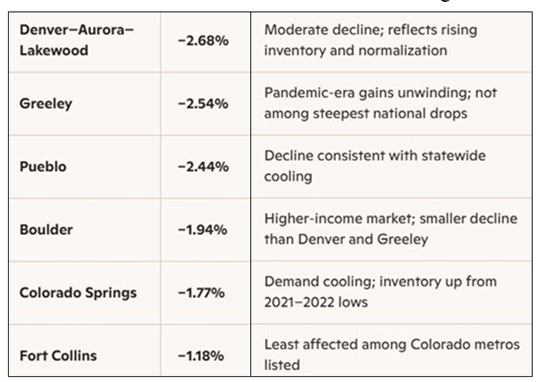
All Front Range Cities Lost Value Year-Over-Year
Grand Junction was the only big Colorado city which was not on ResiClub's list of 77 metro areas posting year-over-year price declines in May 2026.

Nationally, home prices are essentially flat, rising just 0.8% year-over-year, according to an analysis from ResiClub Analytics based on the Zillow Home Value Index. That modest gain is similar to last year’s, but the more important story, felt clearly in Colorado’s Front Range markets as well, is the widening divide between metros with rising prices and those slipping into decline.
ResiClub reports that 77 of the nation’s 300 largest metro areas posted year‑over‑year price declines between May 2025 and May 2026. That’s down from a peak of 110 metros with declines last summer, suggesting the sharp softening that began in early 2025 has stabilized. Even so, the national market remains soft, with appreciation barely above zero and inventory levels still reshaping local dynamics.
Colorado’s Front Range cities all appear in those 77 cities, including Denver (including Aurora & Lakewood), Colorado Springs, Fort Collins, Greeley, Boulder, and Pueblo. While none rank among the nation’s steepest decliners, each is experiencing slower appreciation than during the pandemic boom, with inventory rising unevenly across the state.
The metros seeing the most weakness nationally are concentrated in the Sun Belt, especially the Gulf Coast and the West Coast. Many of these markets experienced the steepest pandemic‑era run‑ups, leaving prices out of sync with local incomes once mortgage rates surged in 2022. Builders in these regions have also added substantial new supply, often offering incentives or price reductions to pull buyers toward new construction and away from resale listings.
By contrast, many markets in the Northeast and Midwest continue to post year‑over‑year gains, supported by inventory levels that remain well below 2019 norms. In some metros, the divergence is dramatic: Hartford, Connecticut, now sits 25.6% above its 2022 peak, while Austin, Texas, remains 27.3% below its peak.
Here’s a breakdown of our Front Range cities: